Without question, 2020 has been a stressful year. Many people are finding themselves spending more time at home and away from social interactions. Families are spending more time in the same house, which can add to stress. Work commutes have transformed into walks to the kitchen or couch. Many people have lost their jobs. Normal activities are reduced. Gyms have gone virtual or closed completely. With cold weather coming, daily walks are becoming less of a realistic option for stress relief. Luckily, using your own body, you can calm down your anxiety and nervous system in seconds! Unlock the power of your diaphragm and reap the benefits of stress relief anytime, anywhere!
What is Diaphragmatic Breathing?
Breathing is a natural part of human life. Most often it is a process that requires little to no thought. Stop reading, and think about your breath. Are you breathing up and down through your chest? This is the most common form of breathing, otherwise known as chest breathing. Chest breathing is not efficient, as it delivers minimal oxygen to your body and bloodstream, all while requiring more energy to perform. Diaphragmatic breathing, or belly breathing, uses your entire lung capacity and is how your body is designed to breathe. This type of breathing slows your heart rate and can help steady your blood pressure. In fact, diaphragmatic breathing is the basis of meditation, the world’s most common form of stress relief.
The diaphragm is a muscle designed for breathing. It is located in the thorax, or abdominal cavity, below the lungs. Contraction of the diaphragm increases the thorax and in turn, inflates the lungs and influences breathing. Your body was designed to use this muscle for breathing, so use it! You wouldn’t use your chest muscles to help you squat, so why do the same with breathing!
So how do you get started with diaphragmatic breathing? Find a quiet place to practice, and let’s begin!
- Find a spot where you can lay on your back with your knees bent up. This is the starting position.
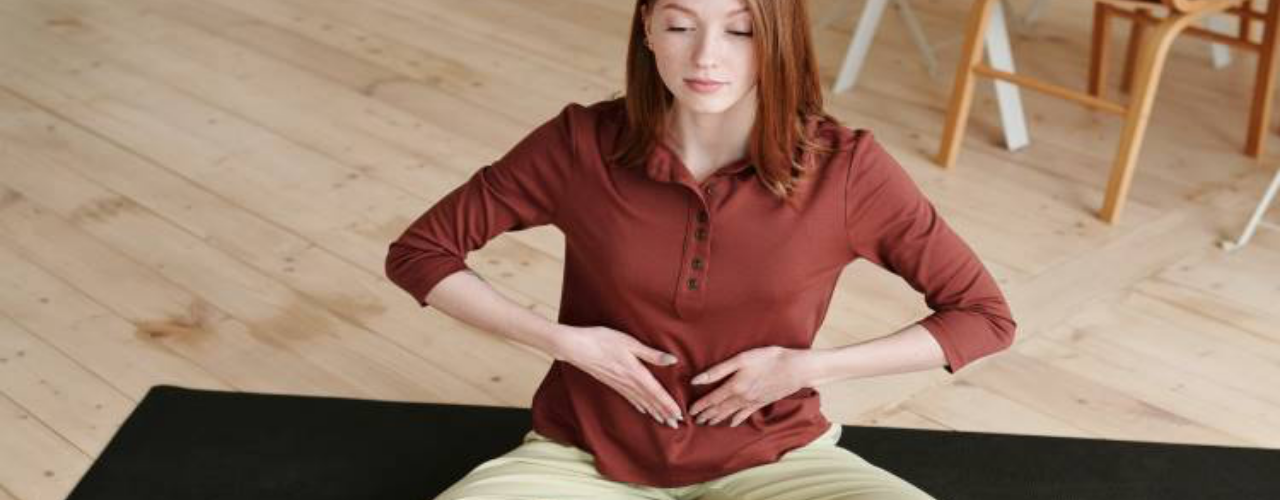
- Place your hands on your stomach, as this will serve as feedback that you are performing the breathing method correctly.
- With a closed mouth, inhale exclusively through your nose to a count of four. Picture yourself breathing up and into the nose as if you were smelling one of your favorite scents.
- After a four-count, breath out through pursed lips to an equal count of four. Visualize yourself blowing candles out on a birthday cake.
Repeat this process for 3-5 minutes, and notice how much more calm and relaxed you feel after! If you are struggling with breathing through your belly, place a light object on your stomach such as a tissue box. Seeing the rise and fall of the tissue box as you breathe can serve as your cue that you are performing the movement correctly.
Now that you have the basics, incorporate belly breathing into your workouts to combat stress and improve the activation of the muscles in your core!
- Plank– Get into a position on the floor supported by your elbows, with legs out straight and your body in a straight line. Rather than simply counting seconds or holding your breath, count breaths! Breath in through your nose and out through your mouth for ten total breaths, and count that as one set.
- Bridge– Start in a similar position to the belly breathing set up by lying on the floor with your knees bent up. At this point, lift your glutes and lower back off the floor. Once in this top position, breath in through your nose and out through your breath for three total breaths, and return your hips to the floor. Perform five to ten repetitions.
- Anti-rotation press– Stand tall, with a long band anchored to a doorway or a banister. Standing perpendicular to the band, press the band straight out in front of you. Once the band is straight out, breath in through your nose and out through your mouth for three total breaths, returning the band to your chest. Repeat ten times each side.
As you can see, diaphragmatic breathing can be done anywhere, with minimal equipment. Commit to trying this form of breathing at least once a day for a week, and notice the differences in how you feel. Once you can master the basics of breathing, incorporate them into your workout programs. Using diaphragmatic breathing during core exercises, such as planks, can be a great way to improve your core muscle activation and get more out of your workout.
If you have any questions about this post or would like to speak with a physical therapist about an injury, give us a call at (978) 263-0007. We would be happy to answer any questions and discuss possible next steps.
Achieve Physical Therapy is currently open in Acton, Bedford, and Sudbury MA. We can see you in the office or by video treatment. If you choose to come into the office, we are following all CDC guidelines including the use of face coverings, cleaning, personal hygiene, and staggering patient appointments to limit how many people are in the office.